Craft & Design
Inside Vylore’s Jewellery Design Philosophy: From Inspiration to Wearable Art
Explore the ideas, details and inspiration behind contemporary silver jewellery design at Vylore.
Every Design Begins With a Thought.
In this article
- What Does Jewellery Design Philosophy Actually Mean?
- Where Does a Vylore Design Begin?
- From Inspiration to Form: How an Idea Becomes Jewellery
- Why Proportion, Silhouette and Detail Matter
- The Role of Contemporary Silver Jewellery in Vylore’s Design Language
- When Tradition Meets Contemporary Design
- When Does Jewellery Become Wearable Art?
- Designed to Be Worn, Not Just Admired
- What Makes a Vylore Piece Feel Distinctive?
- From Design Idea to Your Personal Style
Jewellery becomes personal when a line, curve, texture or proportion reflects how someone sees themselves. Good design goes beyond decoration: it gives a piece intention and identity.
At Vylore, contemporary silver jewellery begins with this connection between an idea and the wearer. The Indian brand approaches jewellery through considered form, refined detail and individual expression. Its silver jewellery is certified and made from 925 sterling silver, while its design direction is shaped by a wider question: how can an idea become distinctive jewellery that works on the body and in real life?
What Does Jewellery Design Philosophy Actually Mean?
A jewellery design philosophy is the set of principles that guides creative decisions. It influences what a designer notices, what is removed, which details remain and how the final piece should relate to the wearer.
Decoration adds visual elements. Intentional design asks why each element is there. In contemporary silver jewellery, a surface, link, edge or empty space should contribute to the whole rather than compete for attention.
The philosophy creates consistency without making every piece look the same. A ring and necklace can share a design language through proportion, structure and detail.
Where Does a Vylore Design Begin?
A jewellery idea may begin with form, feeling, movement or a visual reference. Architecture can suggest rhythm; nature can reveal irregular balance; geometry can offer repetition and precision.
Vylore’s verified inspiration includes history, metals, empires and mythology — part of Vylore’s story. These references are starting points, not objects to be copied. The V&A’s overview of jewellery history shows how forms and techniques have shifted across periods, reinforcing why historical awareness can inform new work without dictating it.
For contemporary silver jewellery, interpretation is the important step. A historical reference might become a simplified outline; architectural rhythm might become repeated links. Inspiration becomes useful when it produces a design decision.
From Inspiration to Form: How an Idea Becomes Jewellery
An initial idea is still abstract. To become jewellery, it must be translated into shape, scale, structure and detail. This is the practical core of the jewellery design process.
Silhouette asks how the overall outline reads from a distance. A circular form may feel balanced, an elongated form may create direction, and asymmetry can add controlled movement.
Proportion considers relationships: band width, drop length, spacing and open space. In contemporary silver jewellery, it can make a simple concept feel deliberate.
Texture and detail shape character. A defined edge may feel precise; a softer transition may feel fluid. Structure determines whether those choices hold together as a wearable object.
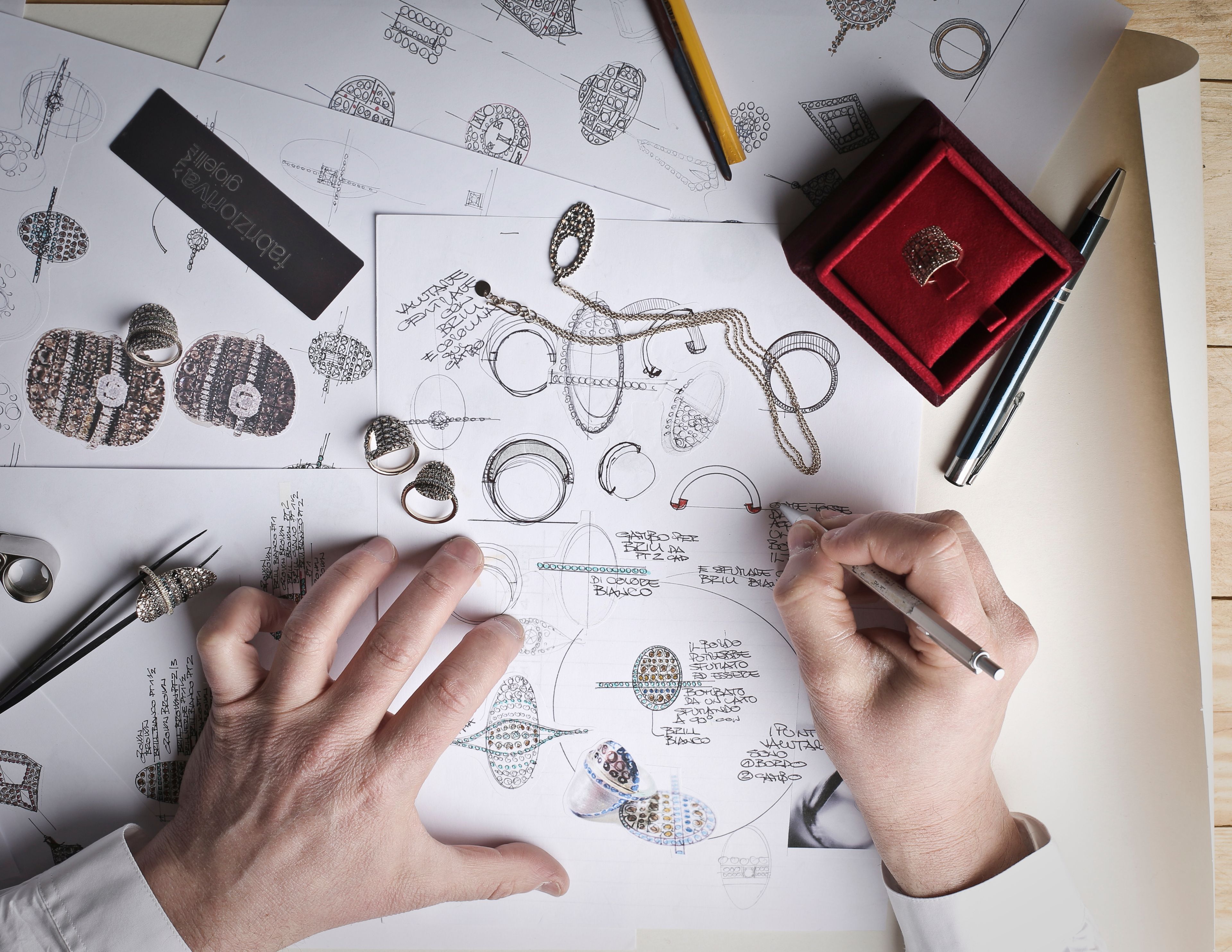
The process is not a straight line. A strong sketch may need simplification when scale is tested. A striking form may need adjustment near the skin. Good silver jewellery design develops through observation, evaluation and refinement.

Why Proportion, Silhouette and Detail Matter
Proportion
Proportion controls visual balance. Changing a few millimetres can alter how a ring sits or how an earring frames the face.
Silhouette
Silhouette is the outline that gives a piece its immediate identity. Geometric jewellery design may use crisp circles, angles or repeated units, while sculptural jewellery may rely on volume and directional curves. A recognisable silhouette helps contemporary silver jewellery remain distinctive even when the details are subtle.
Detail
Detail creates character at close range. It may appear through a junction, edge, fastening, surface or contrast between solid and open areas. Detail works best when it supports the larger idea; unnecessary detail weakens clarity.
Together, these decisions influence movement, weight, styling and repeated wear.
The Role of Contemporary Silver Jewellery in Vylore’s Design Language
Silver gives Vylore a material foundation for clean forms, distinctive silhouettes and refined detail. The brand has confirmed that its silver pieces use certified 925 sterling silver; no specific hallmarking authority is claimed here.
Within Vylore’s design language, contemporary silver jewellery is not one trend. It can be restrained or expressive, geometric or sculptural. Clear form and considered proportion connect the direction.
This distinguishes designer silver jewellery from generic decoration: material, form and use are considered together. For customers exploring silver jewellery online, clear imagery and information should make those decisions visible.
When Tradition Meets Contemporary Design
Traditional and contemporary ideas can coexist. A familiar Indian form may remain recognisable while its scale, outline or surface is simplified.
The key is restraint. Directly reproducing a historical object can leave little room for a new design identity. Interpreting rhythm, geometry or proportion allows contemporary silver jewellery to acknowledge a reference while becoming something suited to present-day styling.
This is not a claim to “reinvent tradition.” It is a specific choice to retain a curve, reduce ornament, change scale or use negative space, allowing modern silver jewellery to feel connected without becoming literal.
When Does Jewellery Become Wearable Art?
Wearable art carries an expressive idea while remaining designed for the body. A dramatic photograph is not enough; wearer, movement and context complete its meaning.
The Design Museum describes Simone Brewster’s work as wearable sculpture and notes how sketches and prototypes help balance material, function and wearability.
That balance matters to contemporary silver jewellery. Sculptural earrings or a sculptural necklace can express a point of view, but scale, weight and movement determine whether the piece works. Design must resolve expression and function.
Designed to Be Worn, Not Just Admired
A jewellery piece changes as the wearer moves. Wearability therefore belongs inside the design process, not at the end.
For contemporary silver jewellery, useful questions include:
- Does the scale suit the area of the body where the piece will sit?
- Is the weight distributed sensibly?
- Will an edge, projection or moving part interfere with clothing?
- Can the piece work with more than one neckline, sleeve or occasion?
- Does it feel like the wearer rather than a costume?
Versatility does not require every design to be quiet. Contemporary earrings can provide a statement, while a designer silver ring can become a daily signature. The aim is not universal appeal; it is a coherent relationship between object, occasion and individual style. Explore Vylore earrings.
What Makes a Vylore Piece Feel Distinctive?
Distinctiveness comes from decisions that belong together. For Vylore, that means intention, controlled proportion, a clear silhouette and refined detail.
In contemporary silver jewellery, even a small shift in spacing or scale can create identity. Geometric earrings may use repetition and negative space; a 925 sterling silver necklace may rely on one strong line. Each choice should support the design rather than act as a separate effect.
Vylore’s positioning—distinctive sterling silver jewellery designed with intention, crafted with precision and made for individual expression—sets the direction. The claim should be judged through the clarity of each design and the accuracy of the product information around it, not through exaggerated superlatives.
From Design Idea to Your Personal Style
The final stage happens when jewellery enters a person’s life—as an everyday element, a statement detail or a repeated personal signature.
Styling contemporary silver jewellery begins with the role you want it to play. Choose one strong silhouette when the jewellery should lead, or combine quieter pieces through related shapes and spacing. Consider the neckline, sleeve, hairstyle and other jewellery already present.
Vylore’s contemporary silver jewellery philosophy returns to individual expression. The object brings form; the wearer gives it context.
Good to know
Frequently asked questions
Contemporary jewellery design uses current ideas, forms and styling rather than following one fixed historical style. It often emphasises intention, proportion, material and individual expression.
Contemporary silver jewellery is distinguished by its design approach, which may include clean geometry, sculptural form, refined detail or unexpected proportions. “Contemporary” describes the design language, not a guarantee of quality by itself.
Vylore has confirmed that its silver jewellery is certified and made from 925 sterling silver. The applicable certification remains available for the relevant products.
Wearable art is an expressive object designed for the body. It has a recognisable point of view while still considering scale, movement, comfort and function.
It may begin with a form, feeling, movement, material or reference. The idea then develops through silhouette, proportion, scale, texture, structure and detail.
Decide whether the piece should lead or support your look. Balance its scale with your neckline, sleeves and other jewellery, and choose combinations that share a shape, rhythm or level of detail.