Style Guide
Vylore Silver Chains: Minimalist, Modern and Statement Styles Explained
Get to know silver chain styles, from simple everyday links to more distinctive designs.
It’s the Little Details That Make It Yours.
In this article
- What Is a Minimalist Chain?
- Understanding Different Silver Chain Styles
- What Is a Paperclip Chain?
- From Minimalist to Modern and Statement Chains
- How Chain Design Changes the Look
- Silver Chain Versus Silver Necklace: What Is the Difference?
- How to Style Silver Chains for Everyday Wear
- How to Layer Silver Chains Without Visual Clutter
- Why 925 Sterling Silver Works for Modern Chain Design
- How to Choose the Right Silver Chain
- Vylore’s Approach to Modern Silver Chains
A chain can look simple until two versions are placed side by side. Change the link from round to elongated, increase its scale, shorten its length or introduce texture, and the result behaves differently against the body and clothing. The metal may remain the same; the design language does not.
Contemporary jewellery increasingly treats chains as complete design objects rather than invisible supports for pendants. Vylore brings that perspective to certified 925 sterling silver jewellery, with an emphasis on intentional form, proportion, wearability and individual expression. This guide explains how to read a chain before deciding how to wear it.
What Is a Minimalist Chain?
A minimalist chain uses a restrained link structure, controlled proportion and clean silhouette to create visual clarity. It is designed to work quietly on its own, support a pendant or provide a foundation for layering.
Minimal does not mean without character. Link rhythm, spacing and finish become more visible when decoration is reduced, so precision matters.
A minimalist necklace may include a pendant while its chain stays restrained. Consider its position, neckline and visibility against fabric.
Understanding Different Silver Chain Styles
Chain names can be useful, but design characteristics tell you more about the visual effect.
Minimalist Chains
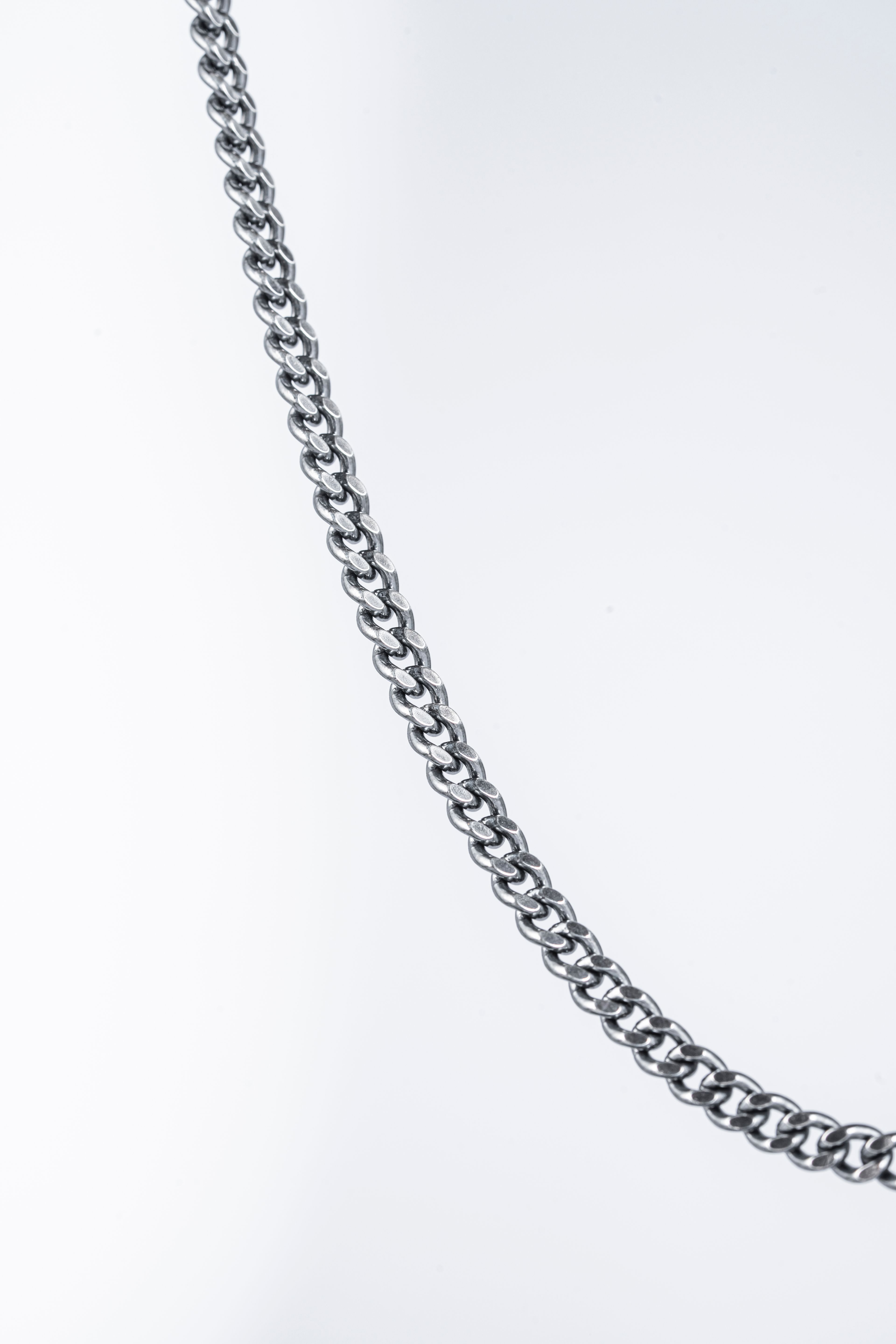
Small links create a quiet outline suited to pendants and layered arrangements.
Paperclip Chains
Elongated links create negative space; larger versions make the rhythm more graphic.
Link Chains
Round, oval, rectangular or irregular units create different texture, movement and density.
Statement Chains
A statement chain becomes the focal point through contrast, articulation or sculptural form—not necessarily size.
Vintage-Inspired Chains
A vintage chain references older patterns or surfaces; “vintage-inspired” does not claim actual age.
Designer Chains
A designer silver chain should reveal a viewpoint through links, connection, scale or finish.
Pendant Chains
These support a silver pendant; chain, clasp and pendant dimensions must be compatible.
Sculptural and Contemporary Chains
These alter link scale, introduce asymmetry or make connections visible.
What Is a Paperclip Chain?
A paperclip chain uses repeated elongated links with open space between them. The stretched oval or rectangular rhythm gives it a clear, graphic appearance.
Proportion makes a paperclip chain minimal or bold. Smaller links look quieter; broader links increase contrast. Alternating scales add expression.
Worn alone, it functions as a modern chain. For layering, pair it with different link density and a clearly separated length.
From Minimalist to Modern and Statement Chains
These labels describe emphasis, not fixed technical categories.
| Style | Primary visual effect | Styling direction |
|---|---|---|
| Minimalist | Quiet, controlled and versatile | Wear alone, add a pendant or use as a layering base |
| Modern | Proportion-led and distinctive | Let geometry or link rhythm remain visible |
| Statement | Stronger silhouette and focal presence | Reduce competing jewellery and outfit detail |
A minimalist chain supports other pieces. A modern chain introduces a distinctive rhythm. A statement chain asks to be read first through contrast, scale, texture or silhouette.
How Chain Design Changes the Look
Link Size and Shape
Small links create finer texture; larger links create separation. Round forms feel softer, angular links more architectural, and irregular links less mechanical.
Length
Length controls where the eye lands: short frames the collar, medium meets an open neckline and long creates a vertical line. Use measurements, not labels alone.
Thickness and Visual Weight
Visual weight depends on thickness, openness, finish and clothing. Open large links may appear lighter than a dense small structure.
Texture and Finish
Polished surfaces return sharp highlights; matte or textured surfaces diffuse light. Finish changes the character and care requirements.
Two chains in the same alloy can create entirely different relationships with clothing.
Silver Chain Versus Silver Necklace: What Is the Difference?
A silver chain usually refers to the linked structure, while a silver necklace describes the complete ornament worn around the neck. A necklace may be a chain alone, a chain with a pendant, several connected chains or a structure with decorative elements.
Shopping language often mixes the terms. A 925 sterling silver necklace may be a chain alone or centre on a pendant, so check what is included. Browse Vylore silver necklaces.
A unique necklace design depends on the chain and focal element. For separate pendants, verify loop fit and compatibility.
How to Style Silver Chains for Everyday Wear
With a T-shirt or dress, a minimalist chain creates a clean line; paperclip links add geometry and a pendant adds focus.
For workwear, consider the shirt collar or blazer. Short chains suit open collars; longer pendants can work over plain necklines.
With sarees and kurtas, read the neckline first. Silver can echo metallic thread or contrast with colour; detailed fabric needs fewer competitors.
For evening styling, let a statement chain lead and keep other jewellery controlled.
How to Layer Silver Chains Without Visual Clutter
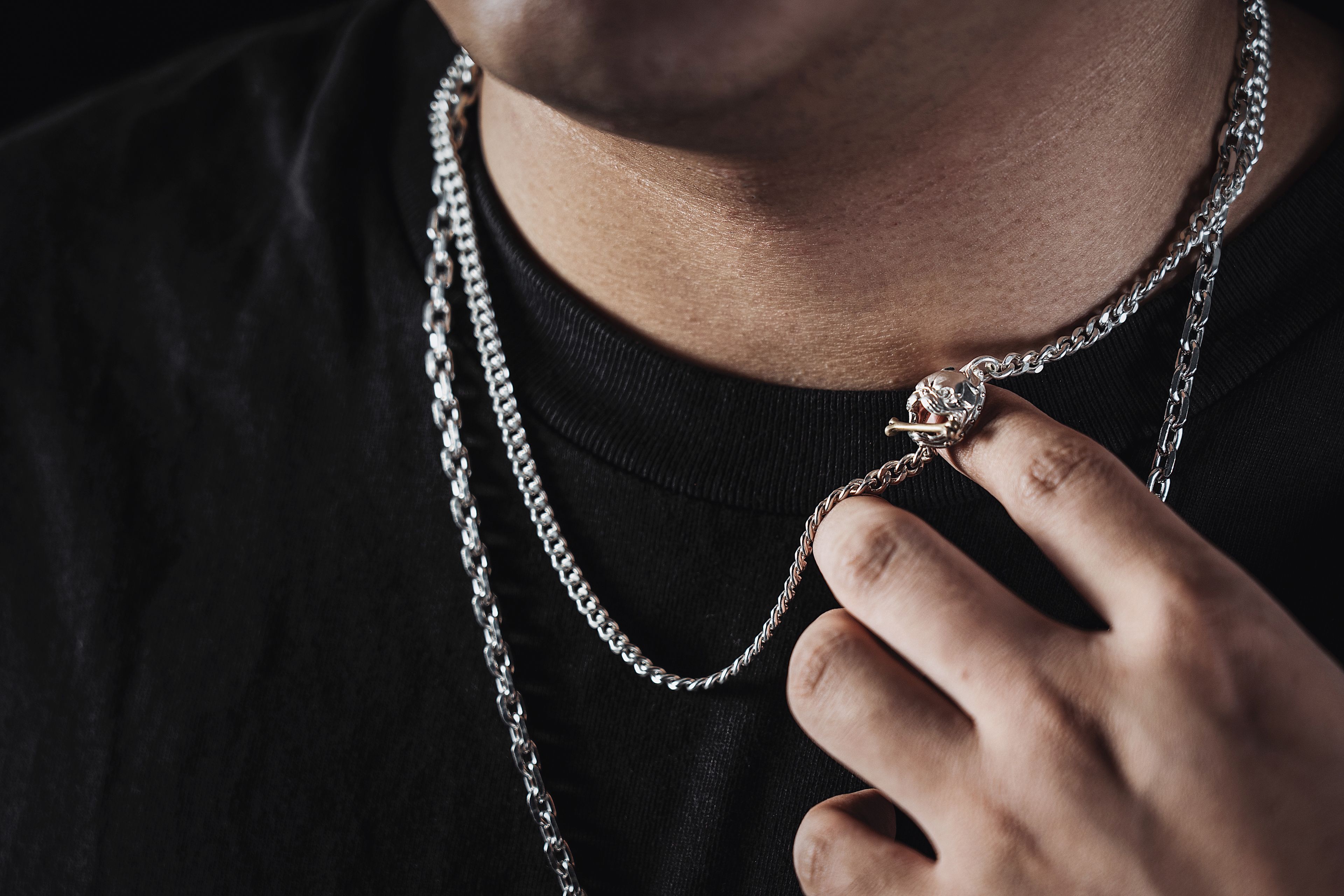
Layer silver chains by separating their lengths, varying link density and choosing one focal piece. Each chain should remain identifiable instead of collapsing into a single crowded line.
Start with a minimalist chain, add a clearly different length and choose a pendant, paperclip link or statement structure as the focus. Repeat one feature across layers.
A unique chain design needs space. Two differentiated pieces often communicate more than four competing ones.
Why 925 Sterling Silver Works for Modern Chain Design
925 sterling silver contains 92.5% silver and 7.5% other metal. The Silver Institute defines sterling silver as .925 fineness and identifies copper as the conventional alloying metal. Alloying gives naturally soft fine silver greater practicality for jewellery construction.
Silver makes link rhythm, texture and negative space visible across minimalist, paperclip and sculptural forms.
Vylore confirms that its silver is certified 925 sterling silver. Review the scope and documentation supplied with a specific product. Certification should not automatically be treated as a BIS-hallmark claim. Care also matters: GIA’s jewellery-care guidance recommends separate, protected storage and specifically notes anti-tarnish storage for sterling silver.
How to Choose the Right Silver Chain
- Personal style: Decide whether you prefer quiet, architectural, vintage-inspired or statement forms.
- Length: Measure where the chain will sit against your body and common necklines.
- Link size: Compare visual impact rather than relying on a style name alone.
- Visual weight: Consider openness, thickness, finish and clothing together.
- Layering: Choose distinct lengths and one focal element.
- Pendant compatibility: Verify dimensions, intended load and connection.
- Material: Check metal, fineness and supporting documentation.
- Construction: Examine links, clasp, joining and surface finish.
- Versatility: Imagine the chain with several real outfits.
- Specifications: Confirm exact length, weight and closure for the actual product.
A custom silver chain or custom chain design requires an agreed scope. “Design your own chain” should not be interpreted as unlimited technical freedom; feasibility depends on construction, material and the jeweller’s confirmed capability.
Vylore’s Approach to Modern Silver Chains
Vylore is a contemporary sterling silver jewellery brand from India creating distinctive jewellery designed with intention, crafted with precision and made for individual expression. Its design-led approach considers silhouette, proportion, detail and wearability rather than treating a chain as a neutral component — see Vylore’s design philosophy.
Vylore’s customisation can respond to agreed design, size and specifications, but chain styles, lengths and closures require confirmation. Link, scale and finish give a chain identity.
Good to know
Frequently asked questions
It is a chain with restrained links, controlled proportion and a clean silhouette. It can work alone, support a pendant or provide a base for layering.
It uses repeated elongated links with visible negative space. Link scale and thickness determine whether it looks subtle or statement-focused.
Match its length and visual weight to the neckline, fabric detail and occasion. Choose whether the chain, pendant or another jewellery piece should lead.
A chain is generally the linked structure. A necklace is the complete neck ornament and may include a chain, pendant or other elements.
Separate lengths, vary link density and choose one focal element. Repeat one colour, finish or geometry to connect the arrangement.
The best option suits the wearer’s routine, comfort, neckline and styling preferences. Check construction and exact product specifications before choosing.
It is widely used for jewellery. Suitability depends on the chain’s engineering, dimensions, finish, intended use and care—not the alloy name alone.